20.7.12

Honor Alexander

Today, July 20, 2012, is Alexandros III's 2368th birthday.
     Born in Macedonia in the summer of 356 B.C. as the son of King Philip the II, Alexander the Great quickly proved to be adaptive, commanding, and intelligent. Aside from the mythology of his divine conception, the temple of Zeus was struck by lightning during the night of his birth, supposedly aligning him with greatness. As a boy no older than twelve, he tamed the wildest horse in a society of horsemen that no other man could master. This horse, Bucephalus, became his war steed after whom armies charged, cities named, and grown men mourned of his passing. By the age of sixteen, Alexander already led his father's army. While the position of the prince heir as leader of the army was not uncommon, for a man so young to display the adaptability in battle that Alexander employed revealed mighty potential. With the assassination of his father, Alexander became king at age twenty. After subduing a far-spread rebellion of his Greek states, he took his army of no more than 30,000 to subdue the Persians, the mightiest empire the world had ever seen. In three major battles, Alexander destroyed all resistance of his Persian enemies, absorbed their fortunes, claimed their land, and became acclaimed as the son of Zeus by the infallible oracle in the Siwa Oasis of Egypt. Not only did he conquer all Persian land, he pushed even farther toward India and only halted because of the exhaustion of his troops. He traversed an uncrossable desert with 80,000 men and died of unknown causes in Babylon a month before his thirty-third birthday. Failing to leave an heir of appropriate age, his generals feigned rule in his name for a decade before claiming territories for themselves and firmly establishing the legend of the Hellenistic world.
     While no man of history lived a flawless life, much can be learned from Alexander, and his character is easily inspiring, especially for young men still seeking to make a mark on the world.

  1. Face Your Fear. From boyhood onward, Alexander never took an injury in his back. His chest, arms, legs, and head were bloodied at one point or another during his decade long campaign. Never did he turn away from his enemy. Once he fell behind a city wall and held off his attackers alone with his back to a tree. He did not surrender and was eventually rescued, nearly unconscious, the bodies of his foes surrounded him and only their spears had been able to harm him after finally wearing down his defenses. After healing, he went on with his army to conqueror even more cities despite the risks.
  2. Take Charge. Once his father died, Alexander became king immediately. Because of his training and years of experience in the army, he was ready for the tasks of leadership when it arrived. He didn't waste time making excuses; he buckled down and got the job done.
  3. Don't Settle for Less. Initially, as his army left Greece, the intention was to defeat Darius III's army and return to Greece to embrace the peace. However, after two victories, Alexander turned down Darius III's offer of co-rulership. The next meeting, the battle of Gaugamela, was the most difficult task his army had faced. Conservative estimates state Alexander outnumbered no less than two-to-one with ancient sources having him outnumbered six or seven-to-one. Quickly assessing the situation, Alexander definitively defeated the Persians and eventually tracked down Darius the III to claim sole rulership of the conquered Persian empire. If Alexander had settled for rulership of the western half, he would undoubtedly have been remembered as a great general of history but never achieved the lasting acclaim for which he is praised.
  4. Honor your Promises. Alexander never lied to his army. After every major battle, he offered to let them turn back if they wished, his only "threat" being that they would miss out on the wealth and legends of victory. With the fall of Persia, Alexander became excessively wealthy but gave the majority of his earnings as awards to generals and heroic soldiers. He paid for statues to honor the fallen and sent large reimbursements back to Greece and Macedonia to enrich the homeland.
  5. Remember those that have Sacrificed for You. Alexander founded many cities as he traveled. While many of these were named after himself, others were named to honor the great generals of that battle or remember a fallen hero. One city of note is Bucephala named after his horse.  When Hephaestion, Alexander's best friend, died, Alexander designed a gigantic burial mound that was said to marvel the pyramids but remained unfinished due to Alexander's own death. Very few walked away from Alexander feeling jipped for services rendered.
  6. Make Friends. Alexander fought many battles. Battles are fought against enemies. Despite this surplus of opposition, Alexander possessed diplomatic skills and often befriended rulers that had opposed him. Instead of killing them and having to leave a proven general behind to run a city, Alexander left many kings in their thrones after swearing loyalty and service to Alexander. Once he had gotten the best of someone, he remained content with having proven superior. The most famous account of this is Porus, the Indian king that opposed Alexander's crossing of the Hydaspes River. Powerful enemies can also make powerful friends.
  7. Push the Bounds of Impossible. This characterizes his life. He conquered the biggest armies in the world, defeated impenetrable cities numerous times, turned Tyre into a peninsula, overcame wounds and poison, crossed the western Egyptian desert and then crossed Gedrosia. Many of Alexander's acts cannot be explained without understanding that the impossible seemed to be the only thing that could challenge him.. He defeated the Persian army three times, he crossed deserts with an army twice, he spent a year making land war against an island, and no warrior could best him. Never did he leave his soldiers to a task without pitching in with more fervor than any other. This habit created a bond with him and his men and cemented their loyalty and love with his mutual suffering of hardships.

     Few men that have lived are as inspirational as his mighty warrior. However, he did make mistakes which we can also take heed to.

  1. Have a Plan. Alexander always did have a plan, especially in battle. However, by refusing to accept anything as satisfactory, his goals constantly expanded and rendered him uncontent with his amazing success. While this was fundamental to his achievements, it also led to his undoing as he pushed his men farther than they were willing to go and damaged their relationship of unwavering loyalty.
  2. Treasure Loyalty. Since he honored those that served him, it may be easy to gloss over the mistakes of judgment he did have. In a drunken rage, he killed Cleitus for false charges of treachery and also had to kill Cleitus's father, Parmenion, one of his elite generals, fearing revenge for Cleitus's death. All this occurred because Alexander had forgotten that Cleitus had saved his life and that Parmenion had been the first to hail him as king at the death of his father, Philip II.
    Despite these faults, Alexander the Great earned his title with his successive victories, legendary achievements, and love from his men. Thus, on this day, his birthday, we can praise history for remembering such a great man to inspire us to greater deeds than mundanity. 
     May your achievements match the undefeated one, founder of the Hellenistic empires, and inspiration through the ages: Alexandros III, the Great.


   __    
Agatha Tyche

5.7.12

Science of Culinary Arts


     For most people in today's world, the concept of a scientist is depicted either by white lab coats, absent mindedness, and anti-social brilliance or, contrastly, as an eloquent genius devoutly solving the world's problems. Chefs, especially on television, are well spoken, efficient, and skilled. Views of both of these practitioners are abstract.
     Many scientists are indeed absent-minded with complex theorems, tangled equations, and quagmiric experiments. Many also are down-to-earth, amiable, and expressive - with no loss to their intelligence. The majority of scientists are everyday people going about their careers to investigate new information and application to the ever-expanding knowledge of mankind.
     Chefs, cooks, and cuisiniers also go about everyday lives though with more time spent in the kitchen than most. The chef is not easily stereotyped either. As with every other profession in life, each person is reflective of his own personality and interests.
     Nonetheless, scientists and chefs are very like each other in their techniques and habits. The scientist works long hours that must be flexible if the experiment is done at a certain time. If something needs to boil at 182° C for three hours, he must be ready to proceed to the next step in the experiment at that time or risk ruining all and repeating his procedure. Likewise, chefs shouldn't mix the sauce with the meat before the appropriate step. The similarities between these two professions is actually remarkable. With closer examination, the parallels seem very exact and much of the instrumentation can be shared between the two with special adaptations for unique purposes.


     Shefs and Cientists  . . .

  • Find new "recipes" and clarify, critique, and perfect older ones
  • Record findings to share with others
  • Perform reliable and repeatable procedures
  • Replace expensive ingredients with cheaper variants if the quality of the product is not too adversely affected
  • Tweak the recipe which can both vastly improve and disastrously destroy the quality
  • Culinary recipes = scientific protocols

     The differences between them are obvious enough. The first thing that comes to mind is that scientists generally don't get to eat the results of their experiments. But what if we combined these two fields? What would that look like? It is already a viable profession with a substantial income and embraced by large corporations. Food chemistry is a highly competitive field used to flavor and preserve much of today's processed foods.
     The kitchen is a lab. So, make sure that the next time you go to make dinner, wear your lab coat, goggles, pants, closed-toe shoes, and to keep your arms out of the mixtures. Remember to follow the procedure and make articulate notes during the process -but don't forget to enjoy!


    __    
Agatha Tyche

26.6.12

Man's Constituents: Karia

     The heart has caused more pain and more joy than any other part of history. It is responsible for erecting great empires, but it is also the cause of morale to falter, the army to fail, and that same empire to disintegrate into the past.
     Kardia, the Greek word for heart, encompasses its full range of potential. Like all the gifts of mankind, the heart is a two-edged sword. Its passions force us to sculpt masterpieces and preform works of wonder. Its drive gives ambition to achieve greatness in ourselves and, further, to inspire others. The soul may stir, the mind plan, but without the heart's energy, no designs would ever be accomplished. The heart is the energy plant of the human body. Its desires coerce our actions.
     Egyptians mythology held that the heart controlled the thoughts since it was responsible for driving passions. After death, the heart was weighed against a feather of the goddess Isis to determine if the heart was weighed down with guilt. This guilt ranged from mistreating others or desecrating a temple to exploiting those socially below you and misusing your resources.
     If these people held the heart's power to such high importance as to have their entire life judged by it after death, modern man should recognize the power that the heart possesses is key to reaching the full potential of life.

     What's a man to do? Use these necessary and valuable components of life to be all he can be.   
1.) Motivation comes from the heart.
2.) Planning develops from the mind.
3.) The sum of these actions are compiled in your soul to forge the individual you are becoming.

    __    
Agatha Tyche

Man's Constituents: Nous

     The mind is the most powerful tool man possesses. Without it our lives become purposeless struggles of self-preservation and reproduction. Using it, however, allows man to beneficially interact with others, improve his surroundings, and draft lofty ideas for the future by integrating knowledge gained from the past.
     The Greek word for the mind, nous, speaks of the cognitive ability to process, direct, and control our actions. The mind gives us our reason - both of logic and causation for action. Thinking, planning, considering, examining, and deciding are all critical components of every day life rendered impossible without a mind. The mind is curious, constantly exploring. To contain it with endless fixation on worthless things or to go periods of time without using it at all is a waste of our great gifts and abilities.
     Aristotle, the great philosopher, was well acquainted with his main control center. Theories on social interaction, inanimate objects, natural forces, and the purpose of life - all were processed by his analytical examination.
"The energy of the mind is the essence of life." ~Aristotle
     As the second part of a man, no one can afford to neglect his greatest asset and the only thing that can't be taken away - your mind. Within yourself, you can go on endless adventures, locate hidden fortunes, rule a nation, defy physics, and explore suggestions for improving the real world around you. Citizens of the Hellenistic world became masters at pushing the boundaries of their minds. The modern Western world almost seems content to let those boundaries contract around him (with several notable exceptions). Constantly push, explore, and expand your mental powers.
     Some thoughts are best left unspoken. However, without a voice, your mind remains incapable of impacting the world.

    __    
Agatha Tyche

Man's Constituents: Pneuma

     Man is a single entity devised and expressed through several elements. The ancient Egyptians believed in seven parts of a man. Each piece played a role both in life and in death. Some were merely physical, some spiritual, others odd mixtures of both. All parts existed and reflected the uniqueness of the individual. This was the first civilization to take a long, hard look at what it took to be who you are, how it impacted others around you, and your life after death.

     The first of the modern Western components is the soul, pneuma. The soul is an eternal reflection on life’s actions. The Greek means “breath” or “to blow” and angles perspective to the energy and liveliness of the soul. The soul is the spirit of life that provides the substance from which life is derived.
     The soul will live for eternity and speaks of the greatness and goodness or wickedness and selfishness expressed during life. Life is the loom that weaves what the soul becomes, every stitch revealing the character of the craftsman.

     A man must be certain that he is creating a piece that will be suitable in the conditions of his afterlife. Picturing life after death as a ship tossed on a sea, it would be foolish for a man to craft a scarf; sails would be much more appropriate. Our decisions in life are reflected in our judgement in death. Pick your convictions and consistently follow them. Achieving goals is more admirable than drifting aimlessly through life and will reflect poorly on you once you've passed through life's opportunities.


    __    
Agatha Tyche

5.6.12

Fortune

Luck. Chance. Fate. Fluke. Odds. Statistics.
     Since ancient times, people have felt that coincidental circumstances bring about life's events from the mundane to the extraordinary.
Good fortune, blessings, God's will, godsend, karma.
     Religion has played a major part in the perception of events'occurrence. Similarly, gambling has produced its own following of bystanders willing take a risk on the turn of the wheel, a streak of luck, or a gut feeling.
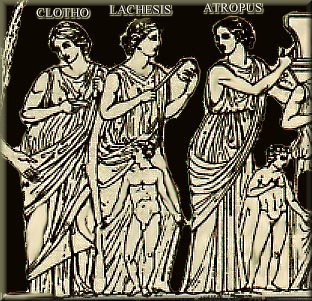
     Whatever inclines a person to believe that the luck of the draw is involved in his life, the historical component in fortune is an overlooked portion of Western culture. The Greeks' Fates evolved into the Roman goddess, Tyche, who was often depicted blindfolded because of the random nature fortune seems to be dispersed through life. She became a prevalent goddess in many occult practices. It was with Tyche's power that love potions, astrological predictions, and other fortune tellings were performed. Interestingly, this perception was not overruled by Christianity in the fourth or fifth century. "God's will" replaced Tyche's predictions, but the belief that a deity controls the random oddities of life persisted.
     Fate, the unchangeable outcome of an event or life, differs from fortune. Fate was seen as set in stone in the early Greek culture exemplified in The Odyssey and The Iliad. However, the Hellenistic world, Rome, and early Christians had a more fluid notion of altering fate with prayers. The medieval world believed that fate could be changed by our actions. Shakespeare's MacBeth, fated to become king, could choose his path to kingship with patience or murder.

     Thus, fortune persevered over cultural and religious changes for millenia. Even today luck is regularly called upon in both religious and secular settings. Regardless of use and context, why is believing in chance, karma, or  luck beneficial? What can we learn or hope to understand by placing our understanding in the idea of odds? Why? Taking an analytical look on human perception . . .
     Bad things happen in life. Inconveniences occur all the time. To prove this fact, go into any room in your house or office and bounce a ball. Soon, the ball will bounce the wrong way and end up hitting something it shouldn't hit or rolling under the one item that is bolted to the floor. The odds of that ball only hitting things that can't be damaged dramatically increases with the cost of that item. Think I'm making this up? Perform the experiment keeping track of where the ball goes in relation to its difficulty to retrieve.
     Belief that luck can interact with our lives teaches people perseverance. "It didn't work out this time. I'm just going to have to buckle down and grind this out again." This is the cause of many people's anger and irritability about life. If you try enough times, eventually, you'll succeed.
     In a religious sense, placing fortune in a deity's hands puts a perspective on man. We learn to respect the limitations of man's control on his own life and the power of man as a species. Thus, we place our desired powers in the hands of a deity to fulfill our ambitions.
     The last lesson we can learn from man's dependence on luck is hope. Hope constantly drives men forward. Why would any person buy a love potion? In hope that is would achieve the desired affect. Superstitions generally play upon the hope of a believer. American sports' superstitions take on absurdity with dirty clothes and odd rituals. Hope pushes a man farther than he thought he could go to achieve the impossible, or if you will, the improbable as his fortunes are played out.


    __    
Agatha Tyche

31.5.12

Mythology to Modernity

Have you ever looked up while reading a book or writing notes and met the eyes of a girl across from you? Your heart does that little skip-jump as your breathing sharpens. You immediately hope that she finds you attractive. Then with great fear and hesitation you consider that maybe your hair is messed up, your shirt is on backwards, or someone is giving you bunny ears. She looks away and you conclude that she was just glancing around the room when you happened to look up and that you not remarkable or especially noticeable. However, she is remarkable.
Every woman is a goddess.
All women have their special brand of beauty. Superficiality is usually the easiest trait to find but rarely the most valuable treasure. Hidden inside, each woman possess a priceless gem. A delightful eagerness for life, undaunted adventure, charming wit, remarkable interests, or inspiring character, all these lend themselves for admiration. Each is unique with the exact combination that makes them attractively who they are. Each is pricelessly beautiful.
Because of this unparalleled beauty, all women deserve the attention of men. Perhaps not the special, amorous attention associated with many duel gender relations, but recognition of her beauty should occur. An authentic conversation, more than the weather or her current mood, will usually turn up a sparkle, a single  gleam of her gem. This prized stone cannot simply be pulled forcefully out and examined! No, it must be worked free and carefully praised. All women have this gem though size, shape, color, and type can vary more spectacularly than any rainbow.
The revealed charm and prized beauty enable any woman to turn a man's head. However, this is a two-sided phrase and not in a physical sense. The first angle is force. Some women, characterized as controlling, use brute force to shake a man's foundation and construct insecurities that enable her views to flourish and dominate. She uses the power of womanhood to dictate a man's movements to conform to her will though commonly in disguise. From a man's view, a more agreeable method is subtly. This women uses suggestion, possibly enticement, to tilt a man's position to or fro. She can incline him in the more desired direction and is satisfied when he reacts, seemingly, of his own accord. Silver tongued, this is the type of women ancient mythologies characterized in their stories and gave her supernatural powers. She is not supernatural, merely a woman, and commands a respect of her own.
Holding these special qualities in mind: beauty, attention, and strength, man needs to concede his love for womankind as a whole. We should cherish and adore the women put in our lives because of the specialty each possesses. All are created in God's image and are, thus, heiresses to His kingdom. They are all actual, physical princesses deserving of our respect and care. Treat women like the princesses they are; very few have ever complained of it.
If a woman is not treated like a goddess, woe to man. A woman's wrath rages as the storm. It possesses uncharted energies and fierceness. While it may appear to slow, she is merely charging for a second blow with pent up forces. The end is unknowable. A woman's anger knows no bounds. The bitterness and resentment of a single woman has been known to completely destroy a man's entire life. Nor can this disturbance be easily settled. Like the oceans after a storm, only time can reduce the ferocity of the waves.
However, without women, society itself turns on end. The most recognized examples of this, the early American frontiers, show men living free and lax lives. Filth, foulness, laziness, and drunkenness abound. Once women entered the scene, settlement and regularity occurred. (Personally, I've concluded this has something to do with each paragraph prior to this. A woman's beauty attracts the men, her charm encourages men to give continuous attention, and she can "suggest" specific changes. These combined, a man must regulate his life to please and praise a woman.) Thus, the absence of women means the utter collapse of society itself.
Women are beautiful creatures that possess powers outside the limited, focused boundaries of a man's mind. Full recognition to each individual should not be above our doing. Chivalry should not die even as women gain their sought equality in society because they are inherently the focus and motivation behind a man's goals.

All women are goddesses.


         __    
Agatha Tyche