28.6.14

"It is nothing."

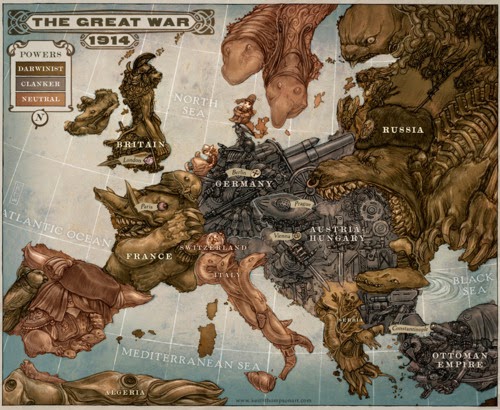
     The causes of the Great War are both many and none. While the revenge the Austrian-Hungary Empire sought on Serbia for the assassination of its heir is noted as the catalyst of the incomprehensible violence of the World War I, the war was long in coming. The rivalries of the great European powers in the nineteenth century created festering wounds that eventually ripped Europe apart. Tensions between France and Prussia, Britain and Prussia, and Austria-Hungary and Russia all combined for tense diplomatic relations that definitively began the destruction of global European hegemony.
     On Saturday, June 28, 1914 at 4:00pm during a visit to Serbia, Archduke Francis Ferdinand, heir presumptive to the throne of Austria-Hungary, and member of the House of Habsburg, was assassinated by Gavrilo Princep, a Serbian nationalist and member of the anarchist group the Black Hand. The death of one man became the death of millions in a four year war that broke the world.


     Despite several failed attempts on his life earlier that day, the archduke visited a hospital to see wounded from a bombing attempt on his life. When it seemed that the stress of the day was nearly over, the motorcade of Francis Ferdinand and his wife crossed paths with another assassination attempt, this one successful. Sophie, Duchess of Hohenberg, wife of Francis Ferdinand, died on the journey to the governor's house for medical treatment. The last words of the archduke were, " Sophie, Sophie! Don't die! Live for our children!" then with a pause, "It is nothing." which was echoed several times.
     "It is nothing," perfectly sets up the cause for Europe's subsequent destruction. Slaughtering itself for nationalist pride above any logical reason, the Archduke Francis Ferdinand seemingly predicted the pointlessness of the next four years.
     Exactly a century after this pivotal moment, the pre-World War world seems naive, ostentatious, and proud. That reflection is through the eyes of cynicism, despair, and death that for decades characterized the thoughts of the West.The two most deadly wars in history began over nothing but ended in a ritualistic suicide of the old world order.
     Today, let us not celebrate death but somberly remember the pain, suffering, and pointless causes that wreak total war, total destruction, and total waste on the world. Let us do better.


 __    
Agatha Tyche.

28.5.14

Lepidoptera


     History is like a butterfly.
     Time is the body that directs the motions and holds the entity together. Its directions seem haphazard, but usually the destination is achieved with unpredicted ups and downs and being blown about in the wind.
     History itself is the wings. As a whole, it is a beautiful, complex image that both confuses and awes. History is somewhat symmetrical and repetitious which is expressed by identical wing patterns. However, altered experiences age time differently and create the tatters on the wings of history that reveal the diversity of the past. History repeats but is not repetitious; it merely echoes the reverberations of time gone by.
As a whole, the story of history is fascinating as are butterflies.. Looking more closely, history, like a butterfly's wings, is composed of smaller pieces. The scales of a butterfly's wings are the individual stories of history from the starving struggle of a beggar to a desperate last stand or how a storm of the century instigated political policies for generations.
Once the shimmering beauty of the scales is rubbed off, the original pattern becomes faint and hard to notice just like lost historical accounts cloud the past.
     The last similarity involves both external and internal influences. History is influenced by time just as the geography is by climate. While man is able to choose his own path, nature and precedent narrow his maneuver's possibilities. A butterfly is buffeted in the wind but can choose to land anywhere it likes while flitting about in the tempest's current.
     Beauty is all around from the big picture to graphic details. Triumph to tragedy, impoverished to impossible, and rare to repetitious, life and history inevitably march on.


 __    
Agatha Tyche

22.5.14

The Pasts' Best Hopes

     The process of living is filled with change. Nothing remains the same, but all change is faced by opposition. Nature resists reconstruction of its surfaces, and in direct opposition to this reluctant transformation, humans constantly carve out, reshape, and innovate while striving to live the best possible life.
     Anthropological accomplishments pass on through history to motivate, inspire, and stand as a testament to the strength of humanity. These innovators of stable, prosperous, and painful change revolutionized their worlds and served to shape the world today both through their decisions as well as the inspiration of their legacies.
     The establishment of an empire is much easier than its consolidation and maintenance. Many ancient empires failed to live on past the second or third generation from the founder. Hammurabi understood the importance of governance in an empire and established the first known written law code. Even today his face decorates many courts because of his recognition that justice is instrumental to the foundation of any government.
     Russia is a geographically large nation, but being outside of the cultural centers of Western Europe and China, she has often struggled to stay with the leading technological edge despite her massive resources. Csar Peter the Great began the modernization of Russia's vast lands in the early eighteenth century. No man can live forever, and after his death, Russia began to slip from its perch near the forefront of the world. The modernization craze did not become recognizably complete until Stalin's efforts from the 1930s-1950s when he transformed the military and industry of a large but poor population into one of the greatest powerhouses in the world.
     Meji the Great transformed the Empire of Japan from a samurai ruled and agriculturally dependent island into the steel war machine that controlled Asia and dominated the Pacific by the mid-twentieth century after only a few decades of dramatic change. The industrial revolution sacrificed traditional Japanese culture in order to maintain self-governance, and with the incredible speed of this transformation, Meji saw Japan succeed in that goal.
     Frederick the Great established the Prussian military's high standards of performance, capable nobles, and cultural fluency. He sowed the seeds of union as Prussian lands, once scattered and unconnected, became a cohesive kingdom that called the German peoples to unite once again into a single, great nation.
     Otto von Bismarck used his talents in political maneuverings and Moltke's military organization to defeat several nations, promote economic growth, and consolidate centuries-divided kingdoms into a powerful Germany.
     Alfred the Great defended his English kingdom against the Vikings, Saladin staved off the Christian invaders of Jerusalem, Thutmose III expanded Egypt's boundaries to previously inconceivable extents, and Napoleon began the modern European age of nationalism, total war, and propaganda-fueled domestic support. Throughout time and place, great challenges have revealed the greatest of man's potential. Nothing stays stable, nothing is permanent, and nothing lasts forever, but as long as mankind is able to push forward, reach farther, and never surrender, he shall persist, thrive, and inspire.


  __    
Agatha Tyche

21.4.14

The End of the World

     Most religions have apocalyptic scenarios in their doctrines. None of the world empires of the past have existed at their zenith of influence and might forever and inevitably succumb to change whether internally, externally, or an alloy of those changes. An unique comparative analysis can be examined when comparing the eschatological hope-fears of the Christian Byzantium Empire and the enthusiastic vigor of the newer Islamic forces.
     An extension of the historical Roman Empire, Byzantium, with its capital of Constantinople, remained strong well into the tenth century if at only a shadow of its former power. The Judeo-Christian belief system upon which the Eastern Roman Empire was founded under Constantine took the promise of Jesus' return "soon" seriously and strove to set up a Christian world empire to begin Jesus' Millennial Reign on earth. This belief motivated the Byzantine's to expand and conquer, especially the areas around Jericho and the Holy Land.
     However, the quick rise of the fundamentally oppositional Islamic power immediately and dramatically reduced the dominating capabilities of the Byzantines. The Byzantine Empire was not unfamiliar with the tides of fortune having long weathered bankruptcy, civil unrest, plague, and military defeat. Initially, even as the empire's strength waned, hope burgeoned, especially in the outskirts of Constantinople's provinces. A variety of groups and belief systems viewed their Roman-founded empire as immortal as the phoenix that must suffer defeat to be renewed to full prominence again.
Overall there seemed to be a fairly popular train of thought that imperial redemption and renewal would start on the outskirts of the Byzantine Commonwealth and be consummated in Constantinople and/or Jerusalem. At least in part this tendency could be explained by the belief that the empire itself needed a renewal, its sacred vitality no longer strong enough to guarantee the empire's triumphant universalism. The power of renewal could no longer be found within Constantinople but outside of it. The shift of focus. of imperial sacred geography from the imperial center to the periphery sought to restore the vitality of mythical Byzantium through the inversion of established canons of imperial sacred space. In the situation in which the imperial center lost its strength, once-peripheral parts of the empire claimed this strength for themselves, positioning themselves as legitimate successors of Constantinople.1
            1  Alexei Sivertsev. Judaism and Imperial Ideology in Late Antiquity (Cambridge, UK: Cambridge University
               Press, 2011), 214.

     As the years wore on without providing a great return of Byzantine might, defeatism set into the culture, and the once proud armies of the Eastern Roman Empire called upon the Franks for military aid. The mighty Christian empire was set to fall.
     On the other side of the spectrum, the new Muslim armies expanded furiously with their own religious urgency in conquering the world because of the basic teaching's of Muhammad warning that the world would end and God would judge all.
What drove Muhammad and his armies to conquer is a subject of deepest controversy . . . it is clear that the common Late Antique themes of universalism and apocalypticism shaped both his message and his method. A significant portion of the Qur'an addresses the Apocalypse (the Last Day, the Overwhelming Event) when God the righteous judge would return and set the whole world to right. Believers were enjoined to a Holy War to prepare themselves and the world for the impending day of reckoning. Muhammad's last recorded speech admonished that 'Muslims should fight all men until they say "There is no god but God."' The goal seems to have been to build a universal righteous community - a melding of Late Antique monotheism with dynamics drawn from deep in the Age of Ancient Empires.2
           2 Eric Cline and Mark Graham. Ancient Empires: From Mesopotamia to the Rise of Islam (Cambridge, UK:
             Cambridge University Press, 2007), 330.

     Byzantium Christendom and the Islamic Empire had the end of the world to spur their conquests; thus, both sides of a centuries long war struggled to convert the world before the end. These two mighty empires used religion to mutual self-destruction.
     In the case of Byzantium, European Crusaders did as much to destroy Constantinople as the Islamic forces. Centuries of war, contraction of governed land by church officials, and reduced tax revenue wore out the Eastern Roman Empire. The Islamic armies fractured under diverging sects and local governors over their vast holdings. Essentially both empires crippled themselves enough for an outside force to have the final impact. The Arab-based Muslim world shifted as Asian Turks took the reigns of the empire, and the Byzantines eventually fell to these Islamic-modified Turks as well.
     In the end both regimes got what they long expected though perhaps neither side predicted the "apocalypse" to be of their empire, not the world. However and whenever man's world ends has been the focus of legends, tales, and religions for millenia. Since we can neither know the day of our own death nor the death of the world, strive to do all you can in the time given to consistently carry out your beliefs and improve upon the world that we do have for as long as we have it.


 __    
Agatha Tyche

3.4.14

Fulfillment

     Only since the onset of the Industrial Revolution has the definition of a nation been considered. A kingdom, empire, duchy, or baronage had centuries of political significance and meaning, but as the common man gained a voice, the identity of the political unit and means of governance changed. Nationalism is a political ideology that attaches member citizens to a nation. During the inconclusive, gory republican revolution in France, individualism took hold of popular imagination. When pseudo-monarchical dictatorship under Napoleon ended the revolution and spurred French armies to invade much of continental Europe, this new, political nationalism spread from its cradle to the enormously diverse tribes, clans, and people groups throughout Europe.
     As the nations of Europe stoked the furnaces of the industrial revolution, historic military rivalries escalated as means of production and population rose. As material wealth increased dramatically in no time at all, these citizen-nations jostled each other over bragging rights. To encapsulate the essence of these views, no matter the state of your people's heritage, you should be proud of your language, religion, and culture. Nationalism is national pride; pride goeth before a fall.
     Nationalism seemed fulfilling. The industrial revolution's wealth and technological adaptations allowed Europe to conquer the world as the Imperial Age took hold of even smaller nations, notably Belgium. At the height of its glory, Europe took slight from any perceived offenses by competing nations, and as the web of inter-national alliances bound Europe together, war was unavoidable.
     As European nations descended into a total war of attrition, colonial populations were called forth to man the war front. Despite the large death tolls, troops from the colonies returned home with their own ideas of nationalism and self-determination. As the infrastructure for maintaining colonies was shelled into the mud of continental Europe, independence movements began in to push back against their oppressive overlords. The major effects of the Great War were to inspire nationalist movements in the colonies and to set the motivation for World War II.
     Just as the War to End All Wars crippled industrial production in Europe that weakened imperial powers, WWII decimated Europe to such an extent that the two decades following saw a nearly complete disassembling of imperial powers.
     Nationalism spurred European nations to reach the epitome of global domination while providing the decimation that destroyed their basis of power.
"Fulfillment" means that Europe was satisfied in their pride, strength, wealth, and might, ever proud of their developments and accomplishments. However, fulfillment also means a conclusion of a promise or prediction, and in that way Europe both fulfilled its desire of world conquest while completing the prophecy of pride.
     Wealth, technology, and cultural perceptions do not a great country make. People make a nation great. Love is stronger than hate. If a nation's people are fueled by hate and fear, they will never succeed, never be satisfied, and never feel safe.

 __    
Agatha Tyche

30.3.14

The Barbarian in Us All

    In the recent centuries of history, Western Europe has been the strong point of the world - invading, conquering, and building, but as Charlemagne, the father of modern Europe, looked out over the North Sea he saw a Viking knarr and said that he feared for his kingdom's future once he was gone. Shortly after Charlemagne's death until well into the eleventh and twelfth centuries, many people near sea and navigable rivers were subjected to Viking raids. These raids had a strong influence on continental Europe and infected the roots of the formation of modern nation states.
     Rollo invaded Paris and raided northern France until he was defeated. He submitted to King Charles and became recognized as a noblemen in exchange for protecting the Seine River. His great-great-great grandson, William the Conquorer, invaded England in 1066 and began the lineage of English monarchs that continue to this day. Nearly a thousand years later this is the last successful invasion of England.
     Rurik was "invited" in by local tribes to rule Kievan Rus' in the 860s. The Russian Tsardom evolved from these early stages but shifted after the Mongol invasions in the 1240s. Russia is an odd mixture of the West and the East, but their passionate convictions, endurance, and energetic enthusiasm credit the strength of the Vikings.
     Finnish, Norwegian, and Swedish tribes raided throughout the European world, the Black and Caspian Seas, northern Africa, Iceland, Greenland, and the coast of North America. Even the Byzantine Empire contended with Viking raids. In all the Viking urge to conquer included four continents: North America, Europe, Africa, and Asia while rendering the Holy Roman and Byzantine Empires mostly incompetent.

     The main reason for the end of their raids was assimilation. As Vikings raided, they also settled and assimilated with local cultures similar to how Rome adopted many of the customs of Greece. In the eighteenth and nineteenth centuries Europeans romanticized the Vikings which soothed away the historic fears the name had invoked for centuries. However, Vikings are still revered as fearsome warriors because of their determination to succeed regardless of injury.
     While the nations the Vikings raided eventually became mighty, the influence of the Northmen has lived on over the centuries because they remained strong, true, and worthy adversaries even as they assimilated. Perseverance, courage, and motivation push men to amazing accomplishments. The more difficult something is the more incredible the accomplishment.    

 __    
Agatha Tyche

9.3.14

An Extroverted Introvert: The American History of Isolationism and Expansionism

     Being an ocean away from its European parents, America has long been an individualist, isolationist nation peopled by self-motivation and determination, yet a nation that was founded to oust external influence now is the most extroverted country in the world which is a complete reversal of its initial political stance.
     The first American president, George Washington, set the tone for American isolationism with his precedent of non-interference and, especially, his Farewell Address.
The great rule of conduct for us in regard to foreign nations is in extending our commercial relations, to have with them as little political connection as possible. So far as we have already formed engagements, let them be fulfilled with perfect good faith. Here let us stop. Europe has a set of primary interests which to us have none; or a very remote relation. Hence she must be engaged in frequent controversies, the causes of which are essentially foreign to our concerns. Hence, therefore, it must be unwise in us to implicate ourselves by artificial ties in the ordinary vicissitudes of her politics, or the ordinary combinations and collisions of her friendships or enmities.
Our detached and distant situation invites and enables us to pursue a different course. If we remain one people under an efficient government. the period is not far off when we may defy material injury from external annoyance; when we may take such an attitude as will cause the neutrality we may at any time resolve upon to be scrupulously respected; when belligerent nations, under the impossibility of making acquisitions upon us, will not lightly hazard the giving us provocation; when we may choose peace or war, as our interest, guided by justice, shall counsel.
Why forego the advantages of so peculiar a situation? Why quit our own to stand upon foreign ground? Why, by interweaving our destiny with that of any part of Europe, entangle our peace and prosperity in the toils of European ambition, rivalship, interest, humor or caprice?
It is our true policy to steer clear of permanent alliances with any portion of the foreign world; so far, I mean, as we are now at liberty to do it; for let me not be understood as capable of patronizing infidelity to existing engagements. I hold the maxim no less applicable to public than to private affairs, that honesty is always the best policy. I repeat it, therefore, let those engagements be observed in their genuine sense. But, in my opinion, it is unnecessary and would be unwise to extend them.
This statement significantly impacted American foreign policy for over a century. The Monroe Doctrine officially stated this U.S. policy from 1823 until 1904.
     The United States, with its incredible ethnic and religious diversities, has always been divided on issues; however, since the debate between Federalists and Anti-Federalists in the 1780s over the Constitution, the "negative" side has always lost. No significant debate in American history has been won by a side that is "anti-" which explains the modern abortion debate labels of "pro-life" and "pro-choice." That said, American foreign policy has always brought domestic disagreement.
     Despite the war hawk nature of the American spirit, foreign policy remained stable until the late nineteenth century. As European nations began to colonize all parts of the world, some Americans feared being left technologically, economically, and militaristically behind the European states.
     From 1880-1904 the anti-expansionist cause fought American imperialist policy. These anti-expansionist "Mugwumps" fought against American claims on overseas territories such as the Sandwich Islands (Hawaii). William McKinley's election to president in 1897 and the Spanish-American War in 1898 drained the anti-expansionists of a political voice. The Spanish-American war was America’s first interventionist war, and it set the tone for America’s foreign policy in the twentieth century.
     The Mugwumps's arguments against colonialism were defeated by the political precedent of America's Manifest Destiny - the century long process of continental expansion and settlement.
     As the long standing isolationist period fell to an imperial ideology, the war hawk blood lust of America faded as well. With the United States policing the Philippines in East Asia and the Banana Republics of Central America, the intensity, cost, and commitment of World War I deterred the general American population from entangling itself with the great European powers. It is fitting that World War I bloodied America's hands as Europe's, for one of the most feared warnings the Mugwumps had stated was that colonial expansionism would end America's militaristic innocence. These warnings were proved true in Cuba, the Philippines, Central America, and Europe - all within a decade.
     As World War I closed, America withdrew once again only to re-emerge in 1941 with a war spirit matched only by Stalin's U.S.S.R. The remainder of the twentieth century revealed how far America would stray from her isolationist roots to become bloodied in the involvement of "liberty" and "independence" around the world. Despite the incredible wealth, love of war, and history of expansion, America was never built to be a ruler nation. Her people's heart has always been isolationist, and her founding document, the Constitution, gives no reference to global involvement.
     America began as a small, independent nation that rejoiced in its separation from the warring countries of Europe. It conquered its whole continent in only a century but could not further restrain its greed for growth. Despite a divided people who wished to leave the world to its own problems, America bathed in the blood of a century to "police" half the world and "protect" lesser nations from the "evil" clutches of its Soviet competitor.
     Finally, after seventy years of war, a decade of fruitless struggle in the Middle East, and a stagnant economy, isolationist sentiment within the United States is growing again. Most Americans are happy to leave the world alone, but the political leaders, hungry for more power, seek to disrupt the "injustices" of the world and "liberate" by subjugation to the American military.
     As difficult as it is to see a people apart from its government, a country is more than its officials. The Islamic nations are undergoing "spring," Eastern Europe is struggling for an identity between the might of Western Europe and Russia, and the two richest nations, America and China, have populations that are happy to leave other nations alone. As diplomacy affects the globalized interconnections of all nations, do not despair that governments are corrupt and power hungry. The majority of people in the world are content with food and friendship, so go about your day with a smile and remember that whatever language or culture people have, life is a blessing.

 __    
Agatha Tyche