31.7.13

The Sagacious Non-King

     Letting go or giving up something that is greatly desired for the cause of another person is the main definition of sacrifice. Though the victor is the one that history remembers, some of the losers are more worthy of remembrance because their achievements, character, or ideology is worth recognition.
     Conrad I, the Younger, was the first German king not descended directly from the Charlemagne line. With his election by the nobles of East Francia (modern Germany) to avoid the absorption of the eastern portion of Charlemagne's empire into the western half, Duke Conrad of Franconia, ruler one of the five most powerful Germanic tribes in the region, was granted power because of a succession crisis. He spent significant portions of his twelve year reign seeking to consolidate power against opposing tribal factions.
     Conrad I never succeeded in solidifying his power, and he was mortally wounded in a battle against one of his rivals. Knowing his demise approached, Conrad instructed his younger brother to offer the crown to Duke Henry of Saxony. Conrad knew that Henry alone among his rivals possessed the knowledge and power necessary to congeal the powers of the warring Germanic tribes. Thus equipped with an alliance between the Saxon and Franconian forces, Henry I succeeded in reuniting East Francia under one king. Henry the Fowler's successor and son, Otto the Great, founded the Holy Roman Empire which became and remained a major power on the European continent for nearly six hundred years.

     Conrad I surrendered his power and lands to his bitter enemy Duke Henry of Saxony to unite the East Frankish Kingdom, secure the autocracy of German dukes, and keep the West Frankish Kingdom out. He gave his power and supporters to Henry bolster unification efforts. Henry I used this power to revitalize the German crown and set the foundation for the Holy Roman Empire; Otto I finished Henry I's actions and succeeded in achieving all of Conrad I's hopes.
     In the face of death, Conrad I sacrificed all his authority and military might to his contender in order to achieve an objective impossible without an alliance. He sacrificed for the love of his people even though it put his antagonist in power. He embraced his own defeat as a sacrifice to raise the authority of the German emperor into such potency as to last through until Napoleon Bonaparte nine hundred years later.
     Winning isn't everything. Sacrifice and compromise can be the best way to resolve a situation to avert pointless stalemate or defeat brought on by division and attrition. Know when to let pride go and seek those who desire your same goals even if slightly different.

 __    
Agatha Tyche

15.7.13

Rock Hard

Your life, soul, who you are is a rock, a steadfast boulder. Perhaps you are like basalt, reflecting things around you with your unique perspective. Or perhaps, you are more like granite with colorful imperfections making your flaws beautiful. Again, your rock may be limestone with a diversity of useful applications. Your rock, whatever it is, represents the true self of your identity. When standing alone, the rock is both a symbolic representation of who you are and your actual self: malleable to an extent but extraordinarily brittle under awkward stresses. Strength lies in the beliefs that direct you toward your goals of achievement, everyday interaction, and, most relevant to this essay, the presentation of who you are in your appearance to others.
Your rock can stand alone, be independent, stand as a monolith, a marker for all to see. Pride is classically said to be green and embitter its possessor, destroying that individual's desire and ability to sympathize and forgive. Instead, think of green as representing a plant: marine algae or terrestrial grass. The green in innocent, even decorative at first, but over time it hides the true rock, your character, covering the uniqueness with the ordinary, yet complex, shades of green. The plant, for which I will claim as algae, grows drawing nutrients and cracking through the base rock, your character, and true self beneath. Should this erosional work continue, the rock will break, crack, shatter, disassemble, and collapse inwardly from the outward force. The root from the plant that is growing into you unproductively uses the nutrients that you have stored.

The algae, for I myself like to think of pride as a scum that clings, resilient to the rock's surface. When it is fresh and wet, it grows, digging into you further, and gets in the way of all else as it hides your real surface. However, when it is dry and hard, stuck tightly onto the exterior, you smell foul as the as the algae attempts to retain moisture and hibernate until needed "again." Either way the rock is hidden beneath the growth.
What can be done?
Nothing - let the algae grow, taking its toll, slight as it is. Keep in mind the order of ecological succession, for, while the algae is small and easy enough to remove, after some time, other, harder and tougher plants take root. Just as a sapling is small and unintimidating, a tree is monstrously large, heavy, and intimidating. To let the algae grow is to abandon yourself to the order of succession and surrender your nutrients to the development of a forest of outgrowth of pride and vices.
Alternatively, to remove the algae is energy intensive, annoying, and difficult. However, to remove the pride or algae while new, saves the rock from scarring and allows it to stand forth as it is truly, not hidden away spending its precious limited allotment of resources in a purposeless forest of vice.
The choice, while easily presented, is difficult. Your choice early on can be undone at any time, but the longer the wait the more impacting the nutrient-sucking roots will be and the less visible your true self will become.
Pride has been called a mask, or, perhaps, a set of scales, but I, with my interest in plants, compare my pride to that of algae: a scum that hides, stinks, digs into, and can remain forever.
It is desirable for aesthetic presentation of no kind. To remove this leech on life is daunting, but its removal leads to the highest rung of bliss and self-satisfaction achievable by the knowledge that you are all you can be.
Scrape your scum away.


  __    
Agatha Tyche

6.7.13

Passions

Ambitions, Passions, Devotion, Drive
These are the fuels that inspire man. These are the causes for change, victory, and success that pepper history books. These are the things that give normal men heart to strive onward through failure to reach their goals.
It is easy enough to break down the success of idolized heroes that achieved greatness: seek a goal, strive forward despite opposition, never quit. The simplicity of success does not remove the need for its application. The most convicted person's passion can fade. The most ingenious man can err, but the one that succeeds will achieve regardless. Greatness can be seen as unexpected or unlikely for those of lower socio-economic standings, but regardless of resources, the persistence to follow passion will accomplish anything it sets out to do.
This consuming passion can pass from a leader to inspire an army to trounce a larger, better equipped enemy, from a single philosopher to individuals that act upon those ideals and create revolutions of mind, matter, government, and society, from a single research paper that incites scientific exploration deeper into theory, atmosphere, ecosystem, or genome. The fire of the desire is what must be protected for mythological greatness to be achieved.
Wild passion spreads, infects, and solidifies its existence, but action, persevering through failure, discouragement, and criticism, awakens the pulse of the goal itself.
Who might we look back on to note their achievements?
Alexander the Great - a charismatic general that inherited a unified Greece and elite Macedonian army. With an army of 30,000, he defeated the largest empire the world had ever seen at the height of its power. Never losing a battle, he onquered the world
Charlemagne - early king of modern day France in a period of war and educational void. He unified the Frankish tribes, united more of Western Europe than any between Rome and Napoleon, reinstituted learning when less than one percent of the population was literate, and set up the basis for modern Europe by acting as an abbot, a loving father, over his subjects. While conquering Germanic tribes to the east and establishing the modern definition of Europe, he struggled to find support from the Byzantine Empire, which he never succeeded in doing.
Genghis Khan - a Mongolian tribesman, he used innovative military techniques that transformed one of the backwoods of Eurasia into the origin of one of the largest empires in the history of the world.
Ludwig van Beethoven - while positioned from birth in a musically enriched family, he proved his substantial abilities but became poor and deaf, yet he still wrote music so energetically that walls and napkins were covered in musical scores.
Leaders throughout time, empire, circumstance, and interest have incited fervent support for their projects. However, passion is larger than mere politics, military intrigue, or economic production. Philosophers, authors, inventors, and those that dared be different achieved that which was thought impossible by reaching through the limiting fabric of realism to achieve what only dreams of determined, insurmountable energy can conjure with a focus that must be admired by others.
You're a nobody? Be a nobody that doesn't quit, that has unrestrained energy for hobbies, goals, and dreams. Be a nobody that matters.


 __    
Agatha Tyche

24.6.13

Solitude

     You know that moment when you feel absolutely alone? Not the alone where you desire distance from everyone else, every possible sound of human life - the other kid, when the pressures and weariness of existence lay so heavily upon you nothing revives your spirit? You desperately seek someone that can hear your pains and worries, embrace but calm your fears, and connect you with unrequitted understanding.
     But you can't because you've distanced everyone you know from your innermost thoughts and emotions. You are unavoidably alone, singular, dispossessed, independent, and unaided by choice because you feared the pain that any sort of relationship causes when its broken. All relationships end: by voluntary, consensual choice, a jarring break caused by distance, emotion, circumstance, or death.
     It's funny how our younger years are so sensitive. As children no one really knows anything and information is just accepted by the brain as it assimilates meaning from its surrounding. That understanding can change, but the impact on the brain is permanent though it can be, eventually, navigated around.
     And that's where I find myself tonight. I am alone, miserable, and gloomy, but I have no one to turn to because I fear the searing, unceasing pain that comes from the falsely dependable comfort of closeness. Once a string is attached to the heart, it is never simply cut loose, always ripped out. Yes, the relational strings we allow to dilapidate, ignored over time, pain less when severed, but the most robust, supportive strings rend the heart in two. That pain, encompassing the entire processing pyche of the person, lingers for too long, always sharp, sharper with time under the haggard circumstances of life that enhances its edge to break through shallow scars of only half-clogged blood.
     I struggled through my notes, books, and memories of the past history of the world. How a nation, people, or figure betrayed by the dearest love overcame this life-shattered, purpose-nulling, eternity-agonizing pain. The answer, revealed in stories, poems, and tales, is time and forgiveness. But that doesn't always work. Often the scarred party is so embittered the entirety of remaining life is consumed with bitter hatred, self-doubt, general loathing and anger. Alternatively, the crushed spirit whimpers and dies from the "broken heart."
I have it in my heart. I am tired of fighting. Our chiefs are killed . . . The old men are all dead. It is the young men who say yes or no. He who led the young men is dead . . . I want to have time to look for my children and see how many of them I can find. Maybe I shall find them among the dead. Hear me, my chiefs! I am tired; my heart is sick and sad. From where the sun now stands, I will fight no more forever. ~ Chief Joseph of the Nez Perce tribe
     If the rock is angled just right, time doesn't dull but sharpen blades. Forgiveness is seen as a profession by those too weak to hold on to anger. Moving on? Impossible.
     Pain isn't a hollow feeling. Pain is the entirety of the substance, but no longer physically impaling like a scrape on your leg when each movement causes a spasm. Emotional pain is a distracting, limiting pain like a dull knife with weights attached slowly compressing into your heart. Always. And every moment of joy guilt, anger, hatred, and bitterness boils up against that joy from the unhealed wound that effuses pain as a well.

     That despair seeps into life and forms a carefully arranged, thick callous around any passage to the heart. If a lasso is thrown, rejection is immediate. If a stab is taken to penetrate the protective layers, violent aversion will directly ensue.
     All this caused by others.
     That's the difference between depressive loneliness and solitude. Solitude is sought to inspire, reflect, relax, comfort, and relieve. However, solitude is worthless if, even in the presence of others, no company or society reprieves self-caused isolation.
     Self-imposed emotional and physical isolation is not healing, but sometimes, it's what dulls the pain the best - though alcohol and other drugs are often abused to cloud memories. Winston Churchill remained depressed most of his life and became known for his particular fondness for drink. One in four U.S. presidents has been historically noted for inexplicable mood swings likely caused by depression. Whether those emotions were bottled intentionally to shield the heart from pain cannot be known because the individuals never expressed them.
     Abraham Lincoln, "I am now the most miserable man living. If what I feel were equally distributed to the whole human family, there would not be one cheerful face on earth. Whether I shall ever be better I cannot tell; I awfully forebode I shall not. To remain as I am is impossible; I must die or be better, it appears to me."
     Theodore Roosevelt, "The light has gone out from my life."
     Edgar Allan Poe, "I have absolutely no pleasure in the stimulants in which I sometimes so madly indulge. It has not been in the pursuit of pleasure that I have periled life and reputation and reason. It has been the desperate attempt to escape from torturing memories, from a sense of insupportable loneliness and a dread of some strange impending doom."
     Another timeless example of trying to erode life's pain: soldiers. In history, life, and literature, soldiers vie against each other to live in the moment. Drink until the mind is blank. Gamble away the spoils gained in blood and death. Bury sorrow in the facade of tough acts of self-preservation. Chase death causelessly to provide the mind distraction from what it is too fully aware.
     There is still something to be learned from the past, present, and pain. Depressive solitude, even if not overcome, does not diminish a life from achieving great things.

__    
Agatha Tyche

5.6.13

Favoritism

     Is favorite best? Most beloved? Most popular? Your pet objects? Why are things favorited? What causes people to choose something preferred or deemed more beneficial than another?
     One of the largest components in creating "favorites" is upbringing and taste. The environment that forms an individual contributes a large portion to his experience. Either that experience caters to and embraces his tastes and interests, or it causes a rebellion to embrace the things directly opposite of that initial upbringing. Further experience and interactions through life will gradually shift these tastes as he ages.
     Coupled with the environmental experience is the association of memories with those particular markers. I have terrific memories from going up to see my grandparents every summer in a small, isolated, backwoods town in Western New York state. Many of my passions and ideals of life stem from the joy developed and landscape explored during those stays. Conversely, grandparents on the other side of my family cherished material wealth and social habits of the higher end of society. As I aged, one situation saw me rebel while the other saw me attraction. The generation of soldiers from the 1940s will be hard pressed to support German industry under any circumstances while the new generations hold little grudge against their German counterparts.
     Emotional stimulation is the last stimulus of favorited items. Psychologists and market analysists attempt to associate activities or feelings with specific emotional states. Colors have an impact on this as well. Many religious movements in the modern West have attempted to ally their teachings with emotional peace and benevolence.
     In the end, one's preference for most things has little impact on on the overall curvature of life. Your satisfaction in life should be unhindered whether your door is brown, white, or green. The pampered, excessively materialistic West throws temper tantrums for favored positions and items while those less privileged are more accepting of adverse conditions. Reexamine your priorities and determine which preferences define your core values to diminish other, simply pleasant, emotional associations that needlessly inhibit key judgement choices of favoritism. 

 __    
Agatha Tyche

23.5.13

Uncomplicated Biology

     Despite the ease of urban life, something seems to stir in man's rigorous society that causes him to long for the freedom of open hills and unexplored land. The open field, virgin forest, uncharted desert, and frontier land has always inspired great deeds and ideals of newness. Doing as no known individual of our species has ever done appeals to a great many people. This trait remains prominent in America, descendants of those who left the old world to venture into "unclaimed" lands.
     The glories of the simple life have been toted since ancient times. Although by modern standards, Alexandria, Egypt under the Ptolemaic Empire remained a small city, it focused creative arts from the far ends of the world. Poets held the life of shepherds as blissfully uncomplicated. Only the repetition of days called. Tending crops, caring for animals, and tending the home were the only "necessary" tasks to life unburdened with the needs of social pleasantries in the cities.
     Though the basic goal of this rural lifestyle is survival, stress is still prominent. Famine, drought, and disease are always factors. Socially, you are trapped with a very small group of people every day of the year usually limited to the ten to fifteen family members living in the house and farming the surrounding land. If something goes wrong, you have limited resources and manpower to accomplish the task. While the "simple life" has been glorified, several powerful reasons have gradually forced humans to congregate in ever increasingly large cities.
     This desire for a "simple life" has been around nearly as long as major civilization. The Hellenestic world, especially Alexandria, Egypt , focused on writing romantic literature (anacronistic terminology) that depicted farm work and animal husbrandry as glorious trades above the gloom of city life. The next time you wish for the simple life, remember the hard work in manual labor, the setting aside of harvest and limited resources to last through the months of unproductive winter. Life is much more dependent on the weather, and increased distance from other people confines relationships with the people in the area.
     Be thankful wherever life has put you. If a time comes to farm the land and store your produce, cherish those life lessons as much as ordering a meal in the restaurant, though the frequency of the second has lost its sparkling appeal for many. Enjoy your life as it is while always grateful for the others around you.


 __    
Agatha Tyche

7.5.13

Dictator Apprehension

     Fear.
     Control.
     It is remarkable how much of life is controlled by fear. We are afraid to step out of our pre-determined boxes and be judged by those around us for not predictably following our reputation. We are afraid to jump in somewhere that we have no experience and pitch in, take charge, do the task. This is true for all ages especially in schools and jobs. Once a reputation is assigned for one quality, even a reputation for disinterested neutrality, any excursions outside of it are fitted as uncharacteristic. A proficient example of this is elementary or junior high school when the teacher yells for silence. Of course, everyone ignores her and continues boisterously until the quietest child in the class screams for silence. Everyone is so surprised, they hush instantly. Nothing changed in their desires to continue the conversation. When the expectations of someone we assume to understand rather well does that unexpected thing, surprise abounds. To avoid that unwanted attention, many of us simply conform to that expected box of our personalities that is affectionately known as a "mask." Our fear of doing the unexpected controls our actions, and we become a stranger even to ourselves.
     This problem is compounded when physically near people more familiar with your habits. The times I have been most uncharacteristic is around people I have never met and run little chance of seeing again. This is also true for my friends. If they meet someone I am acquainted with, they might have acted completely unlike the behavior I expect.
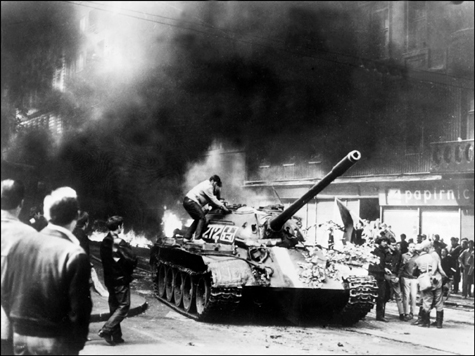
     Historically, many people have had little choice in their daily conduct. The goats need milked, the irrigation canals need cleaned out, firewood needs stacked, and when the work is done, exhaustion forces sleep. In modern times governmental power enforced rigorous conduct laws on citizens. Despite this constant management of both human and physical resources, people eventually took the courage in hand to resist and choose their own desires. The Prague Spring of 1968 revealed the resentment against the United Soviet Socialist Republic in the surrounding puppet nations. This rebellion occurred at the height of Soviet influence, wealth, and military might. The people still opposed.
     Political rebellions reveal the instability of a government. No longer can the law be credibly enforced. The masses arise with bitterness at the mistreatment for an actual or imaginary wrong, and the rebellion is crushed or a civil war breaks out. Ancient Egypt successfully rebelled against the Persian empire's invasion and reestablished native control and religion for a generation. The Greeks defeated Persian advances twice. France successfully repelled British land claims after more than a century of war. America overthrew their perceived oppressors in the British monarchy. Britain resisted Nazi advances and remained unconquered.
     History invariably reveals the desires of a people. With America's social stigmas of nicely situated boxes and divisions, personalities and interests are farmed for cooperation in the work place and monetary expenditures. But if history has taught anything, it is better to resist these outside influences.
     Be yourself. Choose the option most suited to your interests and desires. Don't let your social stereotype paint you into a box that poorly fits your personality and talents. Don't fear the judgement of complete strangers. I have a tendency to act like the people around me. The more time I spend with a single person, the more like them I become. Sometimes this is good; often it is unsatisfying. Be who you want to be. Act as you see right -  not because it is expected but because you honestly are that way. Go about the life you wish to lead without apprehension of the dictator in the public society around you. Just smile, say your greeting, and get doing what needs done!


    __    
Agatha Tyche